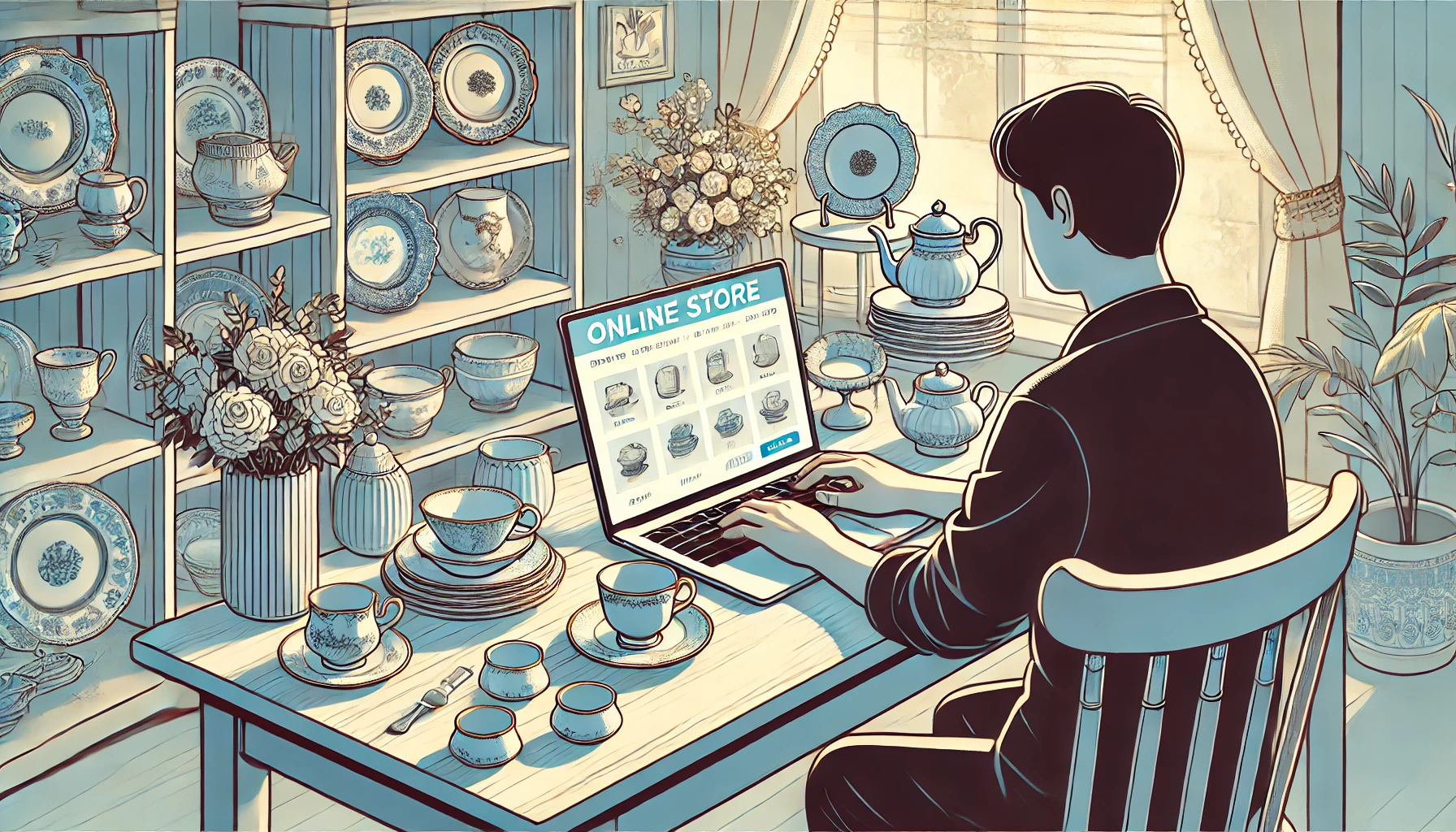
Selling vintage china on Etsy offers a rewarding opportunity for antique enthusiasts and collectors looking to transform their passion into profit. The platform’s massive audience of over 90 million active buyers provides an ideal marketplace for showcasing unique vintage pieces to customers worldwide. This comprehensive guide walks you through establishing your Etsy presence, creating compelling listings, optimizing for search visibility, and implementing effective marketing strategies to maximize your vintage china sales.
Download your Etsy customer emails and start doing email marketing.
Connect your Etsy shop, export customer data, and build powerful email campaigns to boost your sales.
Get Started For Free
To sell china on Etsy under the vintage category, the piece must be at least 20 years old — that is the threshold in Etsy's Vintage Items policy, and it is not negotiable or approximate. Beyond that, three things decide whether a listing sells: correct pattern identification from the backstamp, honest condition and safety disclosure, and packing that survives a parcel network built for shoes, not porcelain. This guide covers all three, plus the piece-mix reality that most sellers get wrong.
Identify the pattern before you write a word
Vintage china is bought by pattern name, almost never by description. Someone replacing a broken plate searches "Royal Albert Old Country Roses dinner plate," not "pretty floral china." A listing without a correct maker and pattern name is effectively invisible to the buyers who pay the most.
Turn the piece over and read the backstamp. It usually carries some combination of:
- Maker — Noritake, Wedgwood, Royal Doulton, Lenox, Johnson Brothers, Homer Laughlin, Mikasa.
- Pattern name or number. Many mid-century Japanese exports carry only a four-digit pattern number; that number is the searchable identifier.
- Country of origin, which dates the piece. "Nippon" indicates pre-1921. "Occupied Japan" narrows to roughly 1945–1952. "Made in England" versus just "England" and the presence of a company registration or backstamp variant can bracket a decade.
- Body type — bone china, fine china, porcelain, ironstone, semi-vitreous. These are not interchangeable and buyers filter on them.
If the backstamp is worn or absent, pattern-matching databases and replacement services such as Replacements, Ltd. let you search by image or shape to identify it. Do the identification work before pricing; an unidentified "vintage floral plate" and a correctly named discontinued pattern can differ several-fold in what buyers will pay.
Condition disclosure, in the language buyers use
Vintage china buyers have a specific vocabulary and they read descriptions closely because they are often matching against pieces they already own. Photograph and describe each of these explicitly:
- Crazing — the fine web of cracks in the glaze. Nearly universal in older earthenware and generally accepted; hidden crazing that appears on arrival is a refund.
- Utensil marks — grey scratch lines from knives and forks. Common on used dinner plates, disqualifying on "mint" claims.
- Gold or platinum trim wear. State whether the band is bright, dulled, or worn through to the white.
- Chips, flea bites, and hairlines. A hairline crack must be disclosed and photographed with the piece held to a light source.
- Ring test. Tap the rim of suspended flatware with a fingernail. A clear sustained ring suggests intact china; a dull thud can indicate an unseen crack.
Photograph at 2000px on the shortest side, under 1MB, in JPG, GIF, or PNG (Etsy Help: Image Requirements), and always include a straight-on shot of the backstamp and a shot with a ruler or common object for scale. Over-flattering photography is the single largest driver of vintage returns.
Lead and safety: disclose it properly
This part gets glossed over on most seller blogs and it should not be. Lead was used in glazes and in the enamels of decorated tableware for much of the twentieth century, and it can leach into food and drink from pieces that were not manufactured to modern standards. The FDA maintains action levels for leachable lead in ceramicware, defined separately for flatware, small hollowware, large hollowware, and cups and mugs, and has issued repeated warnings about decorated and traditional pottery that leaches lead (FDA: Questions and Answers on Lead-Glazed Traditional Pottery; FDA CPG Sec. 545.450).
Practical implications for a seller:
- Do not assert that an old piece is "lead free" or "food safe" unless you have documentation supporting it. Consumer swab tests are qualitative screening tools and are not a certification.
- The safe, accurate framing is to state the age, note that vintage glazes and decorations may contain lead, and let the buyer decide. Many vintage china buyers are collectors and decorators who never intend to eat off it.
- Hand-painted overglaze decoration, brightly colored decorated rims, and heavily gilded pieces warrant the most caution.
- Etsy's Prohibited Items Policy bars items recalled by a government or manufacturer and items that pose a health or safety hazard, so a piece subject to a recall cannot be listed regardless of age.
Separately: gold and platinum trim is not microwave safe and will arc. Metallic trim also degrades in dishwashers. Saying so in the description is accurate, useful, and reduces complaints.
Sell the right pieces, not the whole set
The most expensive mistake in this category is listing a 60-piece service as one lot. Shipping it costs more than most buyers will pay, packing it takes hours, and one breakage compromises the whole order. The market that actually moves is the replacement market: someone who broke one salad plate and wants exactly that salad plate.
What generally sells fastest is dinner plates, serving pieces (platters, covered vegetable dishes, gravy boats, sugar and creamer sets), and complete four- or five-piece place settings. What accumulates unsold is teacups and saucers, which were produced in enormous volume and are heavily oversupplied on the secondary market, and bread-and-butter plates.
Weigh a piece before you price it. A single dinner plate packed to survive transit typically ships in a box weighing two to three pounds once cushioning is included. If the packed weight makes shipping $14 on an $18 plate, the listing will not convert — group that pattern into place settings so shipping is amortized over more value.
Packing that actually survives
- Wrap each piece individually in bubble wrap or foam, taped closed, so nothing touches anything else.
- Stand plates vertically, on edge, like records in a crate. A plate stacked flat takes the full force of a drop across its face; on edge it takes it along the strongest axis.
- Double-box. Inner box fully packed, then at least two inches of cushioning on all six sides inside an outer box. This is the step that separates arrived-intact from arrived-in-pieces.
- Fill every void. If the box rattles when shaken, it is not finished.
- Stuff hollowware. Teapots, cups, and gravy boats need packing material inside as well as out, and handles and spouts get an extra wrap.
Build the packing cost into your price rather than hoping the buyer absorbs it. Double-boxing a single plate consumes real materials, and a broken arrival costs you the item, the shipping, and the refund.
What it costs to list
Publishing a listing costs $0.20, and it expires and auto-renews for another $0.20 every four months (Etsy Help) — which matters in vintage, where individual pieces can sit for a year before the right buyer appears. On sale, Etsy charges 6.5% of the order total including shipping, plus 3% + $0.25 US payment processing (Etsy Fees & Payments Policy). Note that the transaction fee applies to shipping you charge, so a heavy fragile item carries fees on its postage too. Offsite Ads attribution adds 15% of the order total, or 12% once your shop has made $10,000 or more in any 365-day period (Etsy Help).
What does not work
Listing anything under 20 years old as vintage. The rule is a bright line and misclassified listings get removed.
"Fine china" as a title. With no maker and pattern name, the listing does not match the searches buyers actually run.
Claiming food safety or "lead free" without documentation. Understating condition or safety is what turns a sale into a case.
Pricing from published price-guide values. Guides describe asking prices, not sold prices. Price against what comparable pieces have actually sold for in the same pattern and condition.
Single-boxing. No amount of FRAGILE tape substitutes for two inches of cushioning between two boxes.
Questions sellers ask
What is the best way to sell vintage china?
It depends on what you have. Single pieces in identifiable discontinued patterns do well on Etsy, where the replacement-buyer audience searches by pattern name. Large complete services are usually better sold locally — estate sale companies, consignment, or local pickup — because shipping economics defeat them online. Selling directly to a replacement dealer is fastest but pays wholesale, typically a fraction of retail.
Is anyone buying vintage china?
The buyer base has shifted rather than disappeared. Demand for full formal services has declined with changing dining habits, while demand persists among replacement buyers filling gaps in inherited sets, collectors of specific makers and patterns, event stylists and photographers renting or buying mismatched china, and buyers of individual decorative and serving pieces. Selling into that shift — piece by piece, correctly identified — works better than waiting for a buyer of the whole set.
Does vintage sell well on Etsy?
Vintage is one of Etsy's three permitted categories alongside handmade and craft supplies, so the platform actively supports it and the audience is there. Within it, results vary enormously by how well the listing is identified and photographed. Vintage is a category where research quality, not design skill, is the differentiator.
What vintage china is worth money?
Value concentrates in discontinued patterns from established makers with ongoing replacement demand, in serving pieces that were produced in far smaller numbers than dinnerware, in complete undamaged sets by sought-after makers, and in early marked pieces that can be dated to a narrow period. Condition drives everything: a chip or hairline can cut a piece's value dramatically. The reliable method is to search sold listings for your exact maker, pattern, and piece type, and price against those, rather than against the most optimistic active listing.
This article is general information, not legal, safety, or appraisal advice. Product safety obligations and the suitability of any vintage item for food use depend on the specific piece — consult the linked FDA guidance and a qualified professional before making claims about items you sell. Etsy fees and policies change periodically; verify against the linked pages.